ANTIQUES Magazine, March 1941 — THE EDITOR'S
ATTIC 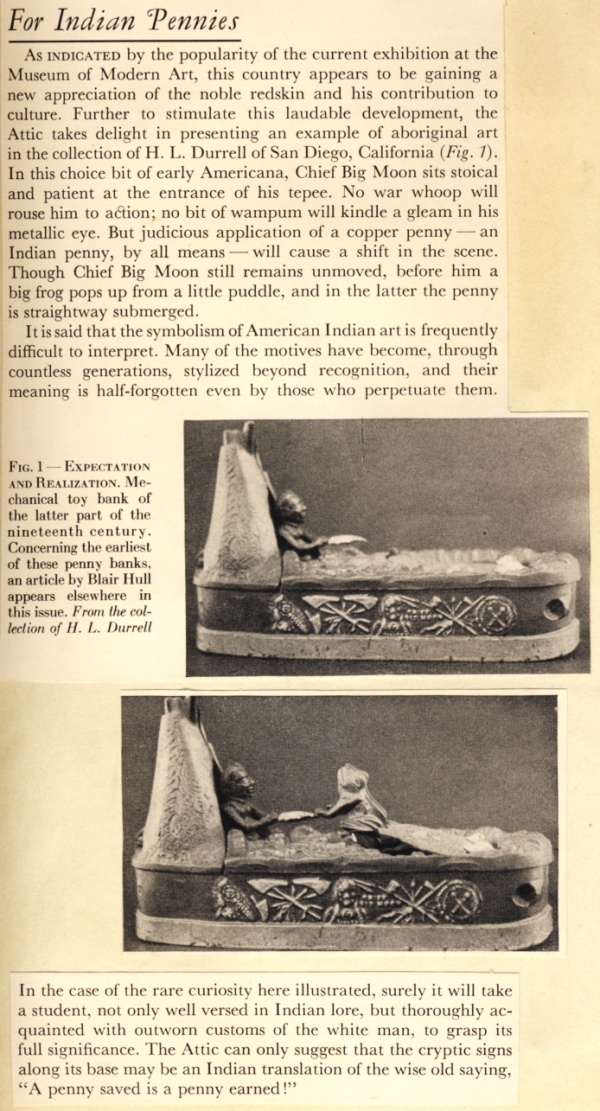 For Indian Pennies As indicated by the popularity of the current exhibition at the Museum of Modern Art, this country appears to be gaining a new appreciation of the noble redskin and his contribution to culture. Further to stimulate this laudable development, the Attic takes delight in presenting an example of aboriginal art in the collection of H. L. Durrell of San Diego, California (Fig. 1). In this choice bit of early Americana, Chief Big Moon sits stoical and patient at the entrance of his tepee. No war whoop will rouse him to action; no bit of wampum will kindle a gleam in his metallic eye. But judicious application of a copper penny — an Indian penny, by all means — will cause a shift in the scene. Though Chief Big Moon still remains unmoved, before him a big frog pops up from a little puddle, and in the latter the penny is straightway submerged. It is said that the symbolism of American Indian art is frequently difficult to interpret. Many of the motives have become, though countless generations, stylized beyond recognition, and their meaning is half-forgotten even by those who perpetuate them. In the case of the rare curiosity here illustrated, surely it will take a student with outworn customs of the white man, to grasp its full significance. The Attic can only suggest that the cryptic signs along its base may be Indian translation of the wise old saying, "A penny saved is a penny earned!" Fig. 1 — Expectation and realization. Mechanical toy bank of the latter part of the nineteenth century. Concerning the earliest of these penny banks, an article by Blair Hull appears elsewhere in this issue. From the collection of H. L. Durrell |
