|
CROMWELL’S IRON TOY INDUSTRY Cromwell Historical Society — July 16, 1976 In 1843 John and Elisha Stevens, sons of a Bristol blacksmith, came to Cromwell (then Upper Middletown) and established a small factory on Nooks Hill Road. They are believed to have been the first manufacturers of cast iron toys in the country. In the early years they produced cast iron hardware, hammers and a variety of simple iron toys, with the greater emphasis on hardware. However, when Russell Frisbie, a native of Branford, joined the firm in 1866 as general superintendent, designer and inventor, the firm expanded rapidly. Production now turned to toymaking. And such toys they were!
Top designers throughout the country gave of their talents and imagination to create increasingly elaborate banks. Encouraged by the strategic placement of a penny, gaily painted figures performed all kinds of actions. There were ball players, clowns, dancers, performing animals. There were also commemorative banks and others which reflected the political and social conditions of the times.
CHIEF BIG MOON — Seated in front of his teepee. The placing of a penny causes a large frog before him to pop up from a puddle, causing the penny to sink.
EAGLE AND EAGLETS — Of the many designers of these banks two names stand out — that of Charles A. Bailey and Dr. James H. Bowen. Dr. Bowen of Philadelphia, Pa., designed many of the finest of the Stevens line, including GIRL SKIPPING ROPE, THE MONKEY AND THE COCONUT and DARKTOWN BATTERY. His work was superior in every way. However, the man considered most talented, as well as the most prolific, was Charles A. Bailey. Born in Cobalt, Conn. in 1848, he did his earliest work at his Cobalt home. He later opened an office in Middletown, where he provided a variety of services, which included pattern making of cast iron banks. About 1890 he entered the employ of the J. & E. Stevens Co. and worked as their chief designer and pattern maker for over 25 years, maintaining quarters on the second floor of the office building. The company also produced a steady succession of still banks. Edwin Warman defines these banks as "Banks usually cast of metal in the shape of animals, buildings, men or other figures, in which a slot is provided for inserting coins". The first safe (still) banks carried a decoration of stenciling. The later ones were of embossed cast iron. While most were comparatively simple, some were elaborate, having separate drawers or compartments. The banks might have a lock and key or, in some cases, combinations. Many were given appropriate names, such as NATIONAL SAFE, etc. In addition, a great variety of other toys were produced and are listed in various catalogs issued by the company, the last dated July 1928. To mention a few — toy cannon, available in ten sizes; stoves, large and small, equipped with pots and pans, and some with boilers; a superior steam engine, developed by Russell Frisbie. The factory supplied much-needed income to Cromwell families for a century. Many men
and women Lastly we come to the manufacture of cast iron cap pistols. The company catalog of 1859 lists "Fire Cracker Pistols". As the firm expanded in the mid-nineteenth century it produced more elaborate models. There were given names. There were also novelty pistols. In the 1890’s Stevens made a cap pistol shaped like a sea serpent with a cap-exploding jaw. Another had a monkey who, at the press of the trigger, banged a coconut down on the cap. These fine early pistols are collectors items today. In later years Russell A. Frisbie (grandson of Russell) and Herman Lorentz designed toy pistols. A 1921 newspaper item states "Herman Lorentz of the J. & E. Stevens Co. has invented a new type cap pistol on which he has been granted a patent. The pistol differs from the ones that have been turned out by the Stevens Co., inasmuch as it is made of sheet metal and the parts are stamped out by a press. They are much neater in finish than the cast iron ones." After 1928 the company devoted itself exclusively to the manufacture of cap pistols. For some years the factory prospered under the able direction of the late Russell A. Frisbie. At one time he stated he felt his masterpiece to be a repeating cap pistol in which the caps were fed through a slot in the hammer rather than through the fixed parts of the toy. As late as 1940 the demand for cap pistols was so great it took six tons of metal a day to maintain the production of this single foundry, where one hundred men made them. However, with the onset of World War II the fires were cooled and the factory closed by the decision of Russell A. Frisbie, because of the government’s need for iron and labor difficulties experienced at the plant. The business was sold to Buckley Brothers, of New York, who continued to make cap pistols there until 1950. Several buildings remain today in the hollow at the foot of the hill. They are occupied by Horton Brasses, The Shipping Crate and others. The cupola still sits atop the old office building, but its bell took a short trip up the hill to Holy Apostles College. Its sound can be heard by those living close by. The waterwheel, which furnished power for two buildings, was removed from the rear of the assembly room building and brought to Middletown a few years ago. Cromwell is a small town. The name of J. & E. Stevens Company is not forgotten here. "Old timers" still speak of it, and more than one middle-aged resident cherishes memories of exciting visits to the foundry and rummages in the discard piles. |
 The name of J.
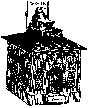
&. E. Stevens Co. is best known today for its marvelous mechanical iron banks. It all
began in 1869 when John Hall, of Watertown, Mass., walked into the foundry office with an
idea for a bank which he wished the company to produce for him. It was to be the first
cast iron, patent-marked mechanical bank to be made. A safe, with "Halls
Excelsior" marked on the front, it works as follows: With the pull of the doorbell
the roof lifts, showing a monkey. Placing a penny on a table causes the roof to close as
monkey
The name of J.
&. E. Stevens Co. is best known today for its marvelous mechanical iron banks. It all
began in 1869 when John Hall, of Watertown, Mass., walked into the foundry office with an
idea for a bank which he wished the company to produce for him. It was to be the first
cast iron, patent-marked mechanical bank to be made. A safe, with "Halls
Excelsior" marked on the front, it works as follows: With the pull of the doorbell
the roof lifts, showing a monkey. Placing a penny on a table causes the roof to close as
monkey It may be of
interest here to name a few of them and describe their actions:
It may be of
interest here to name a few of them and describe their actions:  GIRL SKIPPING
ROPE — A remarkable bank.
GIRL SKIPPING
ROPE — A remarkable bank.  DARKTOWN BATTERY
— The pitcher tosses
DARKTOWN BATTERY
— The pitcher tosses  THE MONKEY AND
THE COCONUT BANK —
THE MONKEY AND
THE COCONUT BANK —  Baby eagles lift
heads, open beaks, mother leans toward them, raises her wings. Inside is a small bellows
which "peeps".
Baby eagles lift
heads, open beaks, mother leans toward them, raises her wings. Inside is a small bellows
which "peeps".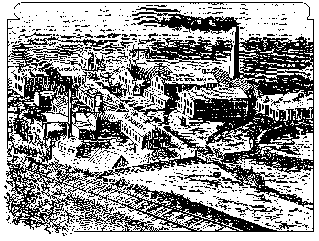 worked here throughout their entire lives. Of these the name of
Kate Ralph stands out. Starting here as a girl of 16, she remained with the company for 63
years. She walked to work, three miles each way, and only missed six weeks for illness
during all that time. The company’s payroll records for 1874 lists the women who
painted the banks, many of whose descendants are still living in this town: Josephine
Bond, Hattie and Nellie Cannon, Annie Drayer, Mary Murphy, Rosa Eager, Lucinda Ralph, Kate
Wilson, Emma Becker, Julia Craw, Eliza Murphy, Mrs. M. Baisden, Mary Weidemeier, Mrs.
Budde, Lizzy Rose, Mary J. Cosgrove, Annie Gleason, W. Mansfield, Kate FitzPatrick, Eliza
Selker, Mary Meyers, Mary Franklin, Mary Ralph, Kate Hayes, Kate Bond, Kate Ralph, Mary
Bacon, Mary Batzner and Emma Decker.
worked here throughout their entire lives. Of these the name of
Kate Ralph stands out. Starting here as a girl of 16, she remained with the company for 63
years. She walked to work, three miles each way, and only missed six weeks for illness
during all that time. The company’s payroll records for 1874 lists the women who
painted the banks, many of whose descendants are still living in this town: Josephine
Bond, Hattie and Nellie Cannon, Annie Drayer, Mary Murphy, Rosa Eager, Lucinda Ralph, Kate
Wilson, Emma Becker, Julia Craw, Eliza Murphy, Mrs. M. Baisden, Mary Weidemeier, Mrs.
Budde, Lizzy Rose, Mary J. Cosgrove, Annie Gleason, W. Mansfield, Kate FitzPatrick, Eliza
Selker, Mary Meyers, Mary Franklin, Mary Ralph, Kate Hayes, Kate Bond, Kate Ralph, Mary
Bacon, Mary Batzner and Emma Decker.